History: your measurements at a glance
In the fifth section, History, you'll find your measurements again – stored only on your device, not in the cloud.
The decibel meter app that makes noise visible
Decibel Radar turns your iPhone or Android phone into a sound level meter, noise radar, spectrum analyzer and AR sound camera. No ads, no in-app purchases, and 100% on-device.
Decibel Radar
Decibel Radar is an app for iPhone and Android that doesn't just measure sound – it makes it visible. It shows you how loud it is (in decibels), which direction a sound is coming from, what it probably is – a voice, a fan or a speaker, for example – and which frequencies it's made of. In AR mode, loud spots light up right in the camera view, much like on a thermal camera.
Everything happens on your phone. Decibel Radar never sends recordings, readings or camera images to the internet, shows no ads and has no in-app purchases or subscriptions. You pay about $1 once and get every feature.
Measure, locate, analyze, see: each section answers a different question about the noise around you. Rotate the 3D scenes with your finger or mouse.
Meter · Sound level meter
The Decibel Radar meter shows you in real time how loud it is right now – in your bedroom, at the office, at a concert or next to a construction site. Your smartphone's microphone becomes a sound level meter.
Radar · Locate noise sources
The radar uses arrows to show which direction sounds are coming from and what they probably are – a voice, a fan, a speaker. That way you'll find the source of a hum, buzz or whine much faster.
Spectrum · Frequency analysis
The spectrum shows which frequencies a sound is made of – from a low hum to a high-pitched whine. So you can tell whether it's the fan, the power supply or the music.
AR · Sound camera
Hold your phone up to the room – Decibel Radar lays a heat map of sound over the camera image. Loud spots glow bright, quiet ones stay dark. So you see noise instead of searching for it.
In the fifth section, History, you'll find your measurements again – stored only on your device, not in the cloud.
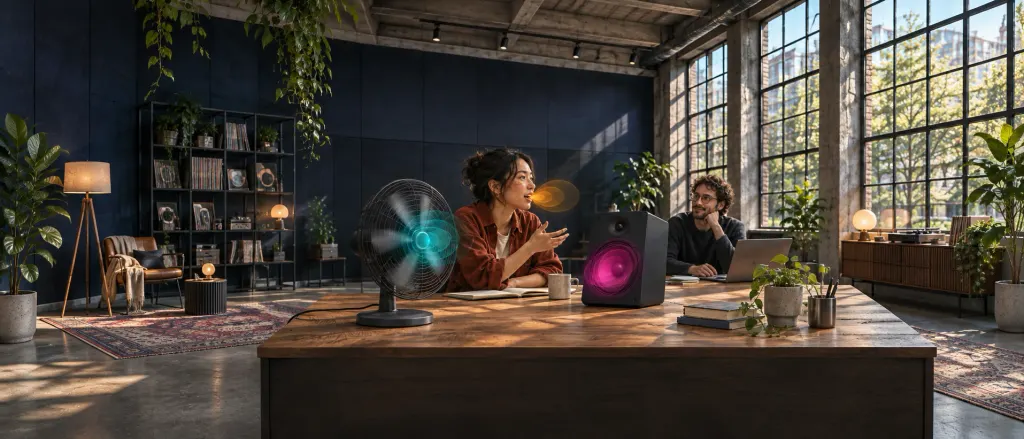
A conversation at the table, a humming fan, music from a speaker: our ears blend it all into one wall of sound. Which source is how loud – and what's actually bothering you – is hard to tell.
Decibel Radar pulls that wall of sound apart. The radar uses arrows to show where each sound is coming from. The spectrum reveals whether it's a low hum or a high-pitched whine. And the meter tells you in numbers how loud it is – so you know whether you should do something about it.
Noise affects almost every part of life. Here's where the app really helps:
Check how loud your bedroom is at night. For restful sleep, the World Health Organization recommends a continuous level of no more than about 30 dB(A) in the bedroom.
Charger, power adapter, router, fridge or boiler pump? The radar shows the direction, the spectrum exposes the tone.
Find out which fan, printer or corner of the open-plan office is the loudest – and where you'll work best.
Above roughly 85 dB over longer periods, your hearing is at risk. A quick look at your phone tells you when ear protection makes sense.
During a viewing, measure the traffic noise at the open window, or gauge how loud the music next door really is.
Drills, circular saws and lawn mowers easily hit 90 dB and more. That way you can tell when it is time to wear hearing protection.
Make sound visible in physics class: with the radar and the AR view, kids instantly understand waves, frequencies and loudness.
How loud is the new vacuum, gaming PC or range hood really? Measure it yourself instead of just trusting the spec sheet.
100% on-device
A microphone and a camera are very personal sensors. That's why Decibel Radar processes everything directly on your phone: sound and camera images are analyzed in real time and never sent to the internet.
No account, no tracking, no ad networks. Recognizing voices, fans or speakers happens on the device – even in airplane mode.
Whispering, conversation, vacuum cleaner, concert: our decibel chart puts readings into context and explains limits for sleep, work and hearing – with sources from the WHO, the EU and NIOSH.
Decibel Radar is an app for iPhone and Android that measures noise and makes it visible. It combines a sound level meter (Meter), a noise radar that shows the direction and type of a sound source, a frequency spectrum, an AR sound camera and a history of your measurements. It is developed by Etzensperger Informatik AG in Switzerland.
In the Radar, Decibel Radar uses arrows to show which direction sounds are coming from and labels typical sources like voices, fans or speakers. In the AR view, loud spots also light up right in the camera image.
Yes. Decibel Radar shows no ads and has no in-app purchases and no subscription. You pay about $1 once and can use every feature.
Decibel Radar is a one-time purchase of about 1 US dollar, or the equivalent in your currency. There are no in-app purchases, no subscriptions and no ads.
Decibel Radar is coming to iPhone (App Store) and to Android smartphones (Google Play).
No. Decibel Radar works 100% on-device. Sound and camera images are analyzed in real time on your device; recordings, readings and images are never transmitted. There's no account and no tracking.
Yes. All features run on the device and also work in airplane mode.
Under good conditions, smartphones with a good app achieve an accuracy of about ±2 dB compared with professional instruments; depending on the model, the deviation can be larger. That's good enough for orientation and comparisons; official measurements require a calibrated Class 1 or Class 2 instrument.
From about 85 dB(A) over eight hours a day, hearing can be damaged. Every additional 3 dB halves the safe time; at 100 dB(A), it's only about 15 minutes.
dB(A) is a level in which frequencies are weighted much like the human ear weights them: low tones count less. For noise, occupational safety and hearing, dB(A) is what is usually used.
Yes, that's what the app is made for: the Radar shows the direction, the Spectrum reveals whether it's a low hum or a high-pitched whine, and the Meter confirms that you're getting closer. Finally, the AR view shows the loudest spot in the camera image.
Decibel Radar is coming soon to the App Store and Google Play. As soon as the app is available, you'll find the direct links here.
Decibel Radar is coming soon for iPhone and Android – for about $1, with no ads and no in-app purchases.
A project by Etzensperger Informatik AGfrom Switzerland.