Meter · Sound level meter
Measure decibels with your phone
The Decibel Radar meter shows you in real time how loud it is right now – in your bedroom, at the office, at a concert or next to a construction site. Your smartphone's microphone becomes a sound level meter.
A sound level meter that's always with you
A classic sound level meter is a separate device you rarely have on hand when things get loud. Your smartphone, on the other hand, is always with you. Decibel Radar uses its microphone to measure the sound level continuously and shows it as a large number in decibels (dB) and on a scale from quiet to loud.
So you can see at a glance whether your bedroom is quiet enough, how loudly the office ventilation hums, or whether you'd better wear ear protection at a concert. You'll find your measurements later in History – stored only on your device.
How to measure properly
Open the Meter
Open Decibel Radar and tap "Meter" at the bottom. The first time, allow access to the microphone – no app can measure without it.
Keep the microphone clear
Hold the phone steady and don't cover the microphone with your fingers or a case. For comparisons, always hold it the same way and keep the same distance from the source.
Measure for a moment
Noise fluctuates. Watch the reading for a few seconds or longer – especially with traffic, music or voices. History helps you spot peaks and quiet phases.
Why the Decibel Radar meter
Live in decibels
The level reacts instantly to every sound – from a whisper to a bass beat.
Private
Sound is analyzed only on the device. Nothing gets uploaded.
No distractions
No ads, no pop-ups, no unlock purchases – just the measurement.
More than a number
When the level is high, the radar shows you where the noise is coming from.
Typical measurements
Bedroom
For restful sleep, the WHO recommends a continuous level of no more than about 30 dB(A) in the bedroom. Measure at night with the window closed and open.
Office and home office
Conversations, phone calls and fans make it hard to concentrate. Check which spot is the quietest.
Concerts and clubs
Music often reaches 100 dB and more. The louder it is, the shorter the safe listening time – ear protection pays off early.
Workshop and yard
Drills, grinders and lawn mowers quickly reach 85 to 100 dB. The meter shows when it gets risky without hearing protection.
Household appliances
Compare vacuums, dishwashers or range hoods in your own home – under real conditions.
Neighbors and traffic
Gauge noise from the street, a construction site or the neighbors. For legal action, however, you need a calibrated measurement (see the questions below).
What a sound level meter measures
A sound level meter measures sound pressure – tiny pressure fluctuations in the air – and converts it into decibels. The decibel scale is logarithmic: +10 dB means ten times more sound energy and is perceived as roughly twice as loud. Even +3 dB doubles the energy, for example when two equally loud devices are running instead of one.
Our hearing is more sensitive to mid frequencies than to very low or very high tones. For that reason, noise levels are usually stated as "A-weighted" values, in dB(A). This weighting counts low frequencies less, much like the ear does.
Smartphone microphones are built for speech, not for lab measurements. Studies – including research by the US National Institute for Occupational Safety and Health (NIOSH) – show that good measurement apps can come within about ±2 dB of a professional instrument under favorable conditions, but accuracy varies from phone to phone. That's plenty for everyday use, comparisons and orientation; official measurements require a calibrated Class 1 or Class 2 instrument according to IEC 61672.
Frequently asked questions
How accurately can a phone measure decibels?
Under good conditions, smartphones with a good app come within a few decibels of a professional instrument; studies cite about ±2 dB. Accuracy depends on the phone model, the case and the level. Phone microphones often can't capture very quiet environments (below about 30 dB) or very loud peaks (above about 100 dB) precisely.
Can I use the app to prove noise from my neighbors?
Decibel Radar helps you assess noise and document when it's loud. But a phone measurement isn't legally valid proof: authorities and courts generally require measurements taken by professionals with calibrated Class 1 or Class 2 sound level meters.
Why do two phones show different readings?
Every phone has a different microphone, a different microphone position and different signal processing. Cases, how you hold the phone and the distance to the source also change the reading. So it's best to compare measurements taken with the same device.
At what decibel level does noise become harmful?
As a rule of thumb, 85 dB(A) over an eight-hour workday is the limit above which hearing can be damaged. Every additional 3 dB halves the safe duration: 88 dB(A) only 4 hours, 100 dB(A) only about 15 minutes.
Does the meter need an internet connection?
No. The meter measures and calculates entirely on your device and also works in airplane mode.
All features
Noise radar
Uses arrows to show where a sound is coming from and what it is.
Frequency spectrum
Shows which frequencies a sound contains – from hum to whine.
AR sound camera
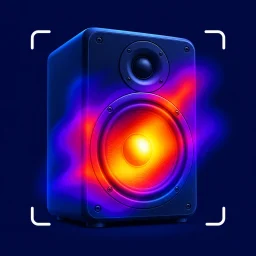
Makes loud spots glow in the camera view – like a thermal camera for sound.
Make noise visible.
Decibel Radar is coming soon for iPhone and Android – for about $1, with no ads and no in-app purchases.